Friday, May 15, 2015

Photo Friday #9: Zenko-ji! フォト金曜日#9:善光寺!

フォト金曜日#9:善光寺!Photo Friday #9: Zenko-ji!

How about a little geography lesson? Japan is an archipelago, consisting of thousands of islands, but is typically portrayed as four main islands: Hokkaido, Honshu, Shikoku, and Kyushu, north to south. The country is further divided into eight regions consisting of 47 prefectures. For example, Kyoto is the capital city of Kyoto Prefecture, located in the Kansai region on the island of Honshu. Honshu--本州, meaning "main province"--is the largest, most populous island of Japan, making it a popular tourist destination.

In this week's Photo Friday post, we're taking a trip out of Tokyo Station on the Hokuriku Shinkansen, bound for Honshu's Chubu region. Sandwiched between the Kanto and Kansai regions (home to Tokyo and Kyoto, respectively), the Chubu region can sometimes be overlooked as tourists pass through to better known locales, but has a charm all its own. Our Chubu destination may sound familiar; we're heading for Nagano, the capital city of Nagano Prefecture, where we visited this Buddhist temple:


善光寺本堂: Zenko-ji Hondo (Zenko-ji Temple Main Hall) - January 4, 2015
If you're a modern-day tourist in Nagano, you're probably visiting with one main thing in mind: winter sports. Nagano is famous for hosting the 1998 Winter Olympics, and its mountainous terrain is perfect for skiing and snowboarding. Indeed, most of the tourists we saw in Nagano were hauling snowboards around with them, and I felt a little out of place without one. However, I still can't forget how painful it was to break my leg playing softball years ago, or how I lived in daily pain for five years following a back injury. Needless to say, I wasn't visiting Nagano for its outdoor sports. (When I saw an Australian girl in full winter gear on crutches in a Nagano convenience store, I immediately assumed her injury was sustained on the slopes, and my fears felt validated.)

When I was researching where we should go during our second trip to Japan--somewhere other than Tokyo and Kyoto--my friend Miho mentioned Nagano. Miho grew up there and went to school near Zenko-ji Temple. The more I read about the area, the more I wanted to visit and see its scenic vistas for myself. It was only an hour and a half out of Tokyo on the shinkansen, plus its cooler temperatures offered the bonus of potentially getting to see snow fall. We added it to our itinerary and arrived on Saturday, January 3.

After having our Sunday breakfast at the Mister Donut near Nagano Station, we headed for Zenko-ji Temple. It's about 2.2 kilometers, or just under 1.5 miles, from the train station to the temple, and as you approach Zenko-ji the road becomes a little steep. (Note that it's a shorter walk to the temple from Zenkojishita Station, but we enjoyed walking and seeing the city.) As it was early January when we visited, many people were presumably still doing hatsumode (the first shrine visit of the new year), so it was a little crowded. However, something struck me as strange as we got closer to the temple: we were the only Caucasian people in sight.

Japan is known for being a homogeneous country, but we saw handfuls of tourists and expats here and there: we met some Australians at Fushimi Inari Taisha, Germans at Tokyo Station, Americans at Roppongi Hills and Kabukicho, British at a pub in Shibuya, and so on. Even our hotel at Nagano was home base for several Australians eager to hit the slopes. But for some reason, Zenko-ji didn't seem to be a destination for other non-Asian foreigners, and we suddenly found ourselves the objects of a lot of attention.


Just some guy with a blonde in a Carp hat.
A group of high school girls approached us and waved, shyly saying "hello" to us; I said "hello" back, and they all giggled ferociously. An old Japanese man greeted us, asking where we were from; he shook our hands, thanking us for coming to Nagano and the temple. I was used to people staring at me in Japan--there aren't many tall, platinum blondes there!--but I was surprised by how amicably we were treated at Zenko-ji. Although Japanese people were usually friendly to us, nowhere else in Japan did so many random passersby make such a genuine, unsolicited attempt to make us feel welcome. It really left an impression on me. It could have felt awkward to be the only non-Asian tourists in sight, but the locals' warm demeanor put me at ease and really allowed me to enjoy strolling the temple grounds.

I wanted to visit Zenko-ji in part because of its rich history. Built in the 7th century, it predates many of Japan's sects of Buddhism, and thus is managed by two different schools--Tendai and Jodo-shu. Like many other temples (remember Kinkaku-ji?), it enshrines images of the Amida Buddha, but what makes it unique is that it houses what's believed to be the first statue of Buddha ever brought to Japan during the 6th century. To say this relic is sacred is a bit of an understatement: it's so revered that even the highest ranking priests at Zenko-ji are forbidden from seeing it, and has been hidden since 654! Every seven years, a treasured replica of the statue--with the replica itself dating back to the Kamakura Period (1185-1333)--is put on public display for a few weeks during Gokaicho, drawing pilgrims and visitors by the thousands. If you're lucky enough to be in Japan right now, you actually have until the end of May to see the Maedachi Honzon statue in person! (The rest of us can watch this video from a few years ago documenting Zenko-ji, the Gokaicho ceremony, and the preparations leading up to it.)

Zenko-ji's other attractions include the Rokujizo, statues of the six Bodhisattvas, as well as an interesting representation of the "key to paradise" of the Amida Buddha. Hanging on a wall in a pitch black, narrow basement corridor, it's said that devotees who manage to touch this metal key can gain enlightenment. Hungry pilgrims can also enjoy various treats from the food stalls lining the road to Zenko-ji. Seeing these vendors is commonplace at larger shrines and temples in Japan, but I especially enjoyed the regional (and vegetarian!) specialties available near Zenko-ji: piping hot oyaki dumplings and gohei mochi.

Centuries ago, it wasn't uncommon for Japanese cities to grow around castles, but Nagano grew around Zenko-ji. With its great "locals only" feel and ancient traditions, a visit to Zenko-ji should be included on every Nagano tourist's itinerary. As Nagano is surrounded by the Japanese Alps and offers tons of fun winter activities, it's easy to overlook the temple--particularly if you're suffering from temple burnout--but the city simply wouldn't exist without Zenko-ji. I know I'm looking forward to returning to the temple, someday!

Friday, May 8, 2015

Photo Friday #8: Mount Fuji! フォト金曜日#8:富士山!

フォト金曜日#8:富士山!Photo Friday #8: Mount Fuji!

In my past Photo Friday posts, I've only shared pictures from Tokyo and Kyoto. Admittedly, that's where I've spent most of my time in Japan, but there's much more to the country than those two cities! With that in mind, today's post takes a trip out of town, with a look at one of Japan's most famous sights:


富士山: Fujisan (Mount Fuji)
A UNESCO World Heritage Site, Fujisan (or Mount Fuji) is located about 80 miles southwest of Tokyo, and can be seen from there on a clear day. With its iconic snow-capped peak, travel to Mount Fuji and its prefectures of Yamanashi and Shizuoka spikes during its official climbing season in July and August. However, views of Fujisan aren't limited to summer hikers: the view in the photo above is similar to one that many tourists will get to see themselves, especially if a trip on the Tokaido Shinkansen is on their itinerary.

Even during Japan's Edo period (1603-1868), Tokyo (then called Edo) and Kyoto were major cities in Japan. The coastal road connecting the two important cities was known as the Tokaido (東海道 : literally "East Sea Road"), and back then, travel along the road was mostly by foot. With the appropriate government documentation, a traveler could walk--or be carried via kago, the jinrikisha's predecessor--from one end to the other, provided the 514 kilometer (or 319 mile) trek wasn't too daunting. Along with the JR Tokaido Main Line, the Tokaido Shinkansen route loosely follows the original Tokaido road...although thanks to shinkansen speeds of up to 300 km/h (186 mph), the journey from Tokyo to Kyoto now takes hours rather than weeks.


Hokusai's "The Great Wave off Kanagawa"
As with the Edo period, Fujisan is easily the most recognizable landmark on today's modern Tokaido route. Not only is it hard to miss as Japan's tallest point at 3,776 meters (12,388 feet--or 2.3 miles), its likeness has also been reproduced countless times in art and photographic prints. Perhaps the greatest contributor to the worldwide appreciation of Mount Fuji comes from artist Katsuhika Hokusai (1760-1849), whose ukiyo-e series "36 Views of Mount Fuji" (富嶽三十六景) helped make Mount Fuji a household name. The series' most popular print is actually its first piece, "The Great Wave off Kanagawa," pictured here. (I have a poster of it hanging in my old bedroom at my mom's house in central Indiana, so I think it's safe to say that Hokusai's art is far-reaching.)

Fujisan's sheer magnitude and beauty has called to people from all walks of life--not just artists and writers--for centuries. The area is believed to have great spiritual power, and the mountain is sacred to the Japanese Shinto and Buddhist religions. Aokigahara (青木ヶ原), a dense forest at Mount Fuji's northwest base, is also (in)famous for being a popular place to commit suicide, and the ghosts of the victims reportedly haunt the trees.

Other modern-day controversies plaguing the area are concerns about garbage littering Mount Fuji's paths, illegally discarded by hikers and others, as well as questions involving when the volcano will erupt again, with at least one estimate naming this year as a possibility. It's easy to forget that Fujisan is indeed an active volcano, as its last eruption was recorded centuries ago in December 1707.

A classically Japanese landmark, seeing Mount Fuji for the first time--even while speeding past on a shinkansen--is truly awe-inspiring. In future trips to Japan, I'm definitely hoping to get a closer look at Fujisan. I won't claim that I plan on climbing it--that's a bit ambitious for a non-hiker like me!--but I'd love to see it while relaxing at onsen in Hakone, or view it during a ride on the Mount Tenjo ropeway. Mount Fuji is such a culturally significant site that merely passing by at 186 miles per hour just doesn't seem to do it justice.

Friday, May 1, 2015

Photo Friday #7: Harajuku shopping! フォト金曜日#7:原宿の買い物!

フォト金曜日#7:原宿の買い物!Photo Friday #7: Harajuku shopping!

Last week, I wrote about Chinzan-so Garden, the serene urban oasis in Tokyo's Bunkyo ward. When thinking of Japan's capital, however, one is probably more apt to picture things that better invoke visions of a bustling metropolis: packed commuter trains, heavy traffic, and rows of skyscrapers that seem to go on forever. For today's Photo Friday post, I'm sharing a view from the ground of one of Tokyo's countless streets--albeit one that isn't for cars:


竹下通り、原宿: Takeshita-dori (Takeshita Street), Harajuku - March 23, 2013
In keeping with Japan's retail culture, Takeshita-dori is one of Tokyo's pedestrian-only shopping streets. A short walk from Harajuku Station on the Yamanote Line, this area is where fashionistas come to play, spending their yen on everything from crepes to false eyelashes to selfie sticks. While Takeshita-dori lacks the polished, upscale aesthetic of Omotesando-dori, the popular neighboring road to the south, it and its many side streets form the true heart of Japanese street fashion and counterculture. It's gritty, it's crowded, it's noisy...it's effortlessly cool.

Bordered by the gorgeous green spaces of Meiji Jingu (or Meiji Shrine) and Yoyogi Park on its western edge, Harajuku's innumerable tiny shops on narrow alleys help fuel the rise of the hottest Japanese fashion trends. From decora to visual kei to sweet lolita, there's a little something for everyone. And if you're less into style and more into comfort (and cheekiness), you can still find an irreverent new T-shirt like I did, designed by Gokigen Factory.

In recent years, Harajuku has received a lot of attention, due in part to publicity from western entertainers. In her 2004 solo debut "Love. Angel. Music. Baby." Gwen Stefani heavily referenced Harajuku (though unfortunately mispronouncing it), drawing inspiration from its unique fashion scene. She co-wrote the song "Harajuku Girls" and hired four Japanese backup dancers--also known as the Harajuku Girls, going by the names Love, Angel, Music, and Baby--to appear with her in music videos, on tour, and in interviews. Even her fashion brands, particularly Harajuku Lovers, showcase her affection for the area.

Not surprisingly, Stefani's affinity for Harajuku is also shared by other pop songstresses. Lady Gaga always makes it a point to visit Dog--one of the many boutiques tucked away in basements--when she's in Tokyo; Nicki Minaj celebrates Harajuku's eclectic style with one of her alter egos; and just last week, Katy Perry was seen in the area wearing a fuzzy mask, akin to those made by gonoturn, with a schoolgirl outfit. (The article claims it was a "'look-at-me' ensemble," but honestly, it was pretty mild [dare I say...basic?] compared to most things seen every day in Harajuku.)

Western celebrities aren't the only ones highlighting Harajuku: from fashion blogger to model to singer, Kyary Pamyu Pamyu has evolved into an international superstar, casting a spotlight on Harajuku in the process. With viral hits like PONPONPON, her debut album, もしもし原宿 ("Moshi Moshi Harajuku"), came out in 2011; since then, she's released three more albums, and continues to work with Yasutaka Nakata (the producer of Japanese bands Capsule and Perfume). She's absolutely everywhere in Japan, appearing on variety shows, in magazines, and in commercials. I'm not ashamed to say that the decision to buy the New Nintendo 3DS while I was in Japan was strongly influenced by Kyary's Nintendo ads. かわいい だ よ!

In the 2009 video below, you'll see a 16-year-old Kyary ("Carrie" in the subtitles) on the streets in Harajuku...and then at home, quarreling with her mother about her fashion choices. After interviewing Kyary, the program profiles an American expat who fell in love with lolita fashion while stateside. And, bonus: five minutes in, you'll meet Minori, the most popular shironuri artist today. (Be sure to watch from 6:50 til the end for more Harajuku looks, too!)


With Shinjuku Station--the world's busiest train station--two stops to the north and Shibuya Station--a bishoujo/bishounen shopping mecca--one stop to the south on the Yamanote Line, Harajuku and Takeshita-dori may seem like a blip on the average tourist's radar. Sure, Harajuku Station is a little grungier than others, and the area holds the dubious honors of both being the only place I saw a rat in Japan (apparently rats love crepes too!) and the only place I felt threatened (ok, but let's keep it relative: it's still Japan, so the passing fear I felt on that random back street is still less than the fear I feel in my own U.S. neighborhood), but visiting Harajuku gives you a raw, firsthand look at the youthful undercurrent of modern Japanese society, far removed from anything you'll see in America.

...well, maybe you will see it in America, but it'll be five years from now--ten if you're here in the midwest--and Japan will have already cycled through a dozen new trends by then.

Friday, April 24, 2015

Photo Friday #6: Chinzan-so Garden! フォト金曜日#6:椿山荘!

フォト金曜日#6:椿山荘Photo Friday #6: Chinzan-so Garden!

In the past two Photo Friday posts, I contrasted old with new in Kyoto, showing that there's more to the nation's former capital than just temples and teahouses. But what of Tokyo? As I've mentioned in a past post featuring Ueno Park, Tokyo isn't just a concrete jungle: throughout the city are numerous green spaces and parks, and innumerable shrines can be found wedged between skyscrapers and houses. In this week's Photo Friday post, I take a look at another favorite urban oasis:


椿山荘: Chinzan-so Garden
I initially discovered Chinzan-so not because of its gardens, but because of its lodging. Prior to our first trip to Japan in March 2013, we (somewhat spontaneously) took advantage of a deal from Globotours we saw on LivingSocial. Included in the travel package was a round-trip flight from LAX to Narita with Singapore Airlines, plus a stay for a few nights at Hotel Chinzan-so Tokyo, which had just rebranded from a Four Seasons hotel to an independent hotel. As frugal people, we normally wouldn't get to experience something like this--we typically stick to budget airlines and lodging--so we jumped at the chance.

Located in the Sekiguchi area of Tokyo's Bunkyo ward, Chinzan-so and its surroundings--once known as Tsubaki-yama (椿やま), or Camellia Hill--have a rich history. 17th century haiku poet Basho lived nearby, no doubt drawing inspiration from the wild camellias and rolling hills. In the 19th century, ukiyo-e artist Ando Hiroshige featured the area in his series One Hundred Famous Views of Edo (名所江戸百景) in the April 1857 woodblock print Basho's Hermitage and Camellia Hill on the Kanda Aqueduct at Sekiguchi (せき口上水端はせを庵椿やま).


Hiroshige's depiction of Camellia Hill

Shortly after being featured in Hiroshige's work, Yamagata Aritomo--an Imperial Army Field Marshal and Japanese Prime Minister--bought the land in 1878, giving it the name Chinzan-so, or "House of Camellia." In addition to his military and political accomplishments, he enjoyed Japanese garden design as a hobby (otherwise seen at Murin-an in Kyoto), and so began shaping the land into the Chinzan-so we know today.

In 1918, Yamagata willed the land to Baron Fujita Heitaro, head of a construction company, who then began decorating the gardens with artifacts from across the nation, most notably a shrine and a three-story pagoda. The Shiratama Inari Shrine (白玉稲荷神社) was relocated in 1924 from Shimogamo-jinja in Kyoto (and is watched over by a Fushimi Inari Taisha deity!), and you can receive your fortune via omikuji (御神籤) from a coin-operated machine there. The pagoda Entsukaku (圓通閣), as seen in the photo above, was moved in 1925 from Chikurin-ji Temple in the mountains of Hiroshima; it was said to have been constructed without nails by Chikurin-ji monks either during the Heian (794-1185) or Muromachi (1338-1573) periods.


Other relics can be found throughout the gardens--stone lanterns, monuments, and more--which the hotel plots on maps both online and on hard copies for guests. With World War II came the destruction of much of the gardens, though the pagoda, shrine, and 500-year-old sacred tree were spared. Reconstruction on the gardens began in 1948, and upkeep on the grounds and its structures continues today.


As you can tell from the smattering of autumnal colors in the photo above, this picture wasn't taken during our first trip to Japan: we returned to the hotel and gardens for a night's stay in December 2014, as a treat during our honeymoon. It seemed appropriate, as Chinzan-so is not only famous for its gardens and hotel, but today also functions as one of Tokyo's most popular wedding sites, offering both Western and Shinto ceremonies. During both of our stays at the hotel, we caught glimpses of a few wedding ceremonies; they're so common that you can see a wedding party in the bottom right corner of the photo above!


Replete with historical artifacts--albeit relocated--the gardens' 17 acres are a picturesque haven from the hustle and bustle of Tokyo, and the opulent hotel offers elegant accommodations and an exceedingly friendly, hospitable staff. It's also relatively easy to access: it's a (somewhat steep) 10 minute walk from the nearby subway station, Tokyo Metro's Edogawabashi Station on the Yurakucho Line, or a (somewhat long) 30 minute walk from Mejiro Station on the Yamanote Line. (After a few of those 1.5 mile walks from Mejiro Station--on an unwittingly broken ankle, I might add--we wisened up and learned how to use the buses, a cheaper option than a ~¥750 t
axi ride.)

Taking a leisurely stroll through the gardens, walking under the waterfall, gazing at the serene pond...it's all a refreshing change of pace after experiencing sensory overload in places like Shinjuku and Shibuya. Indeed, aside from the skyscrapers looming in the background, it's easy to forget that you're still in the city. Just like there's more to Kyoto than just temples and teahouses, there's more to Tokyo than just concrete and neon.

Friday, April 17, 2015

Photo Friday #5: Kyoto Station! フォト金曜日#5:京都駅!

フォト金曜日#5:京都駅!Photo Friday #5: Kyoto Station!

If you're a regular visitor here, you'll notice that I like to discuss how Japan's juxtaposition of old and new makes the country a fascinating place to explore. As a Millennial American, I come from a country that was still adding states to its roster after my parents were born, so the fact that Japan's oldest companies have been in business for more than a millennium is a concept almost too foreign to comprehend.

In previous Photo Friday posts, I've shared some of my photos of Kyoto with you: first, we visited Heian-jingu, a "new" shrine by Japanese standards; then, we explored Kinkaku-ji at Rokuon-ji and learned about its rich history. Although both of these historic sites feature new construction--fires are problematic for wooden structures!--they're still basically indistinguishable from centuries-old shrines and temples. If I only shared photos of Kyoto's traditional architecture, I'd only be doing you a great disservice and furthering stereotypes about the city. With that in mind, here's this week's photo:


京都駅: Kyoto Station
Considering my previous posts, you might think this is a photo of a busy train station in Tokyo, but it's actually a shot of the interior of Kyoto Station (京都駅 or Kyoto-eki), taken in March 2013. Modern and bustling at all hours of the day, this structure stands in stark contrast to how many people, even today, view Kyoto: it's not all temples, teahouses, and geisha.

The first Kyoto Station opened by imperial decree in 1877, and since then has undergone several facelifts and additions, whether out of necessity--as the station was destroyed by fire in 1950--or modernization--as the subway line opened in 1981. Built in honor of the 1,200th anniversary of Kyoto's founding as the capital of Japan, today's Kyoto Station--its fourth iteration, opened in 1997--is a result of a design contest won by Japanese architect and professor Hiroshi Hara. All of the contest entries were modern in design, and as this 1991 article from The New York Times explains, not everyone was happy about it: its detractors claimed that its ultramodern design didn't represent the old soul of the city, but its supporters argued that such a bold look was necessary to keep the city abreast of changing times.

The photo above is a view of Kyoto Station's Karasuma Gate, the north side of the station, as seen from a couple floors up near Cafe du Monde and Mister Donut. It's busier than the Hachijo Gate on the station's south side, and offers lots of things to see: it's home to Porta and The Cube, two underground shopping malls; an 11-story Isetan Department Store (with two underground levels); souvenir shops and convenience stores; hotels and restaurants; a post office; and the city's bus terminal. In the winter months, the station can get quite chilly, especially in this section: it's open to the elements, and even clerks and shopkeepers wear coats inside their stores.


Google Maps version of a typical Kyoto tourist map
For many Kyoto tourists, Kyoto Station sits at the bottom, or south end, of much of where they'll do their sightseeing, as many of Kyoto's temples, shrines, and places of interest lie northward. Indeed, most of the tourist maps provided free of charge in Kyoto show the station as one of the southernmost areas. The map to the left approximates a real-world view of these tourist maps, which are sometimes squished to fit on a certain size paper or pamphlet. I've added markers for a few places I've discussed here on meauxtaku: the yellow marker at the top is Kinkaku-ji, the brown marker to the southeast is Heian Shrine, the red marker southeast of center is Kyoto Station, and the orange marker southeast of Kyoto Station is Fushimi Inari Taisha. To give you an idea of scale, it's just over four miles (as the crow flies) from Kyoto Station to Kinkaku-ji. Between the city buses, subway, and trains operating out of Kyoto Station, reaching any of these places is a breeze.

Despite the controversy of building such a state-of-the-art structure in a city known for its antediluvian architecture and traditions, Kyoto Station provides the perfect place to disembark on a Kyoto journey: its glass and steel facade is the shining face of modern Japan, its innumerable shops and stores a staggering testament to the country's retail culture...but walk a few minutes in any direction and you're sure to stumble upon one of Kyoto's thousands of shrines and temples, transporting you to bygone eras rooted in ancient rituals. History is alive and well in Kyoto, but thanks to structures like Kyoto Station, perhaps no other city in Japan offers such a stark contrast between archaic and futuristic.

Thursday, April 16, 2015

New logo! 新ロゴ!

新ロゴ! New logo!

Notice something different? Scroll up! That's right: I sat down and finished my blog logo! モタク are the katakana characters mo-ta-ku, which is how you pronounce "meauxtaku." This is the same idea behind the pronunciation of my alias merimeaux, or メリモ: me-ri-mo. Easy peasy!


Old school モタク concept sketch
If you think the image looks familiar, then you might be a fan of home-cooked Japanese food: it's a parody of the Otafuku Foods logo, a company that manufactures Japanese condiments and pantry staples for sale both in Japan and in the U.S. You can't have proper okonomiyaki without Otafuku brand Okonomi Sauce!

Doesn't ring a bell? Perhaps you're thinking it resembles something out of Japanese culture and history, which is also correct: "otafuku" (お多福), which means "much good fortune," was a woman from Japanese mythology associated with happiness. Even today, her likeness can be seen on masks at Japanese festivals and on good luck charms at shrines. Otafuku Foods' own website offers some insight into the history and symbolism behind their namesake. It's an interesting little read!


Still doesn't sound familiar? Well, maybe you've been visiting my Redbubble shop, where you may have come across a similar design. When I was making okonomiyaki one day, I reached for my Otafuku Okonomi Sauce, and realized that the katakana for "otafuku" (オタフク) closely resembled that of "otaku" (オタク)--in fact, one could easily be mistaken for the other--and was thus inspired to create an otaku-fied parody. (Want to see the results? Here's the Japanese version, and here's the English version.) I guess rather than being a parody of the Otafuku Foods logo, I should say that my blog logo is a parody of my redone Otaku design...a parody of a parody. Mind blown.


So what's the deal with all this crazy parody inception? Well, one of the things I do for a living is create and design pop culture parodies. Ever since I was a kid, I've loved taking two seemingly unrelated things, finding some kind of common ground, and combining them to make something new. With my art, I aim to create something that makes people think: whether it's humorous, nostalgic, or a tongue-in-cheek social commentary, I want to invite people to look at our world differently. 


Parodies abound on my desk!
This brings me to another thing I love about Japan: it's basically a country full of parodies. You can call it fan art, you can call it character licensing, but parody is at the heart of all the cute and crazy crossovers. You can't even walk up the street leading to Kinkaku-ji in Kyoto without seeing T-shirts for sale parodying Boss Coffee. (You may have heard of Boss Coffee because of American actor Tommy Lee Jones' longtime involvement with the brand, appearing in commercials, on billboards, and on vending machines.)

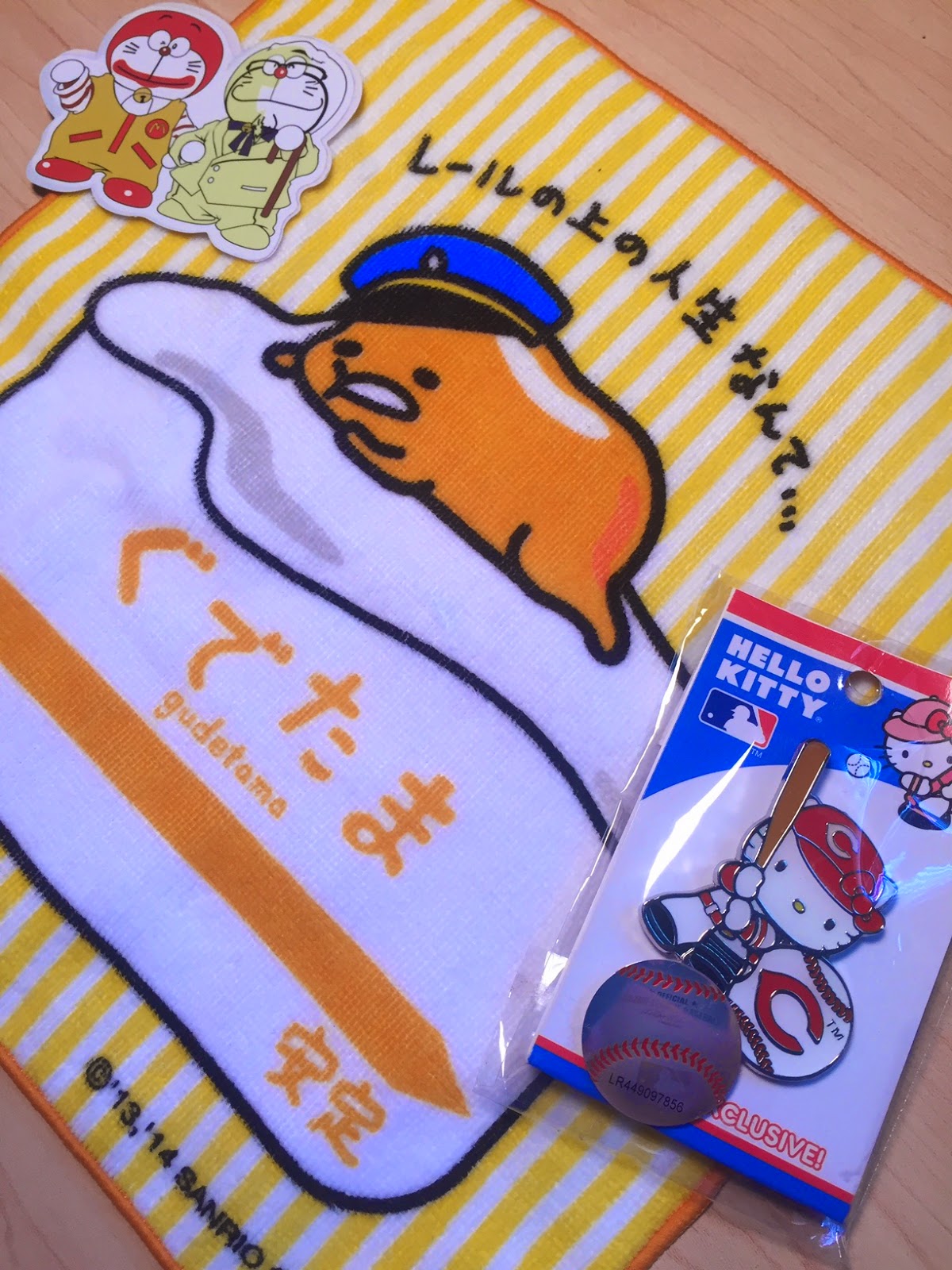
The image to the right shows three things I randomly found here in my workroom that illustrate my point: at the top, a sticker of beloved Japanese character Doraemon dressed as Ronald McDonald and Colonel Sanders (strangely enough, Japanese love McDonald's x KFC fan art); in the middle, Sanrio mascot Gudetama on exclusive train-themed merchandise only available at Tokyo Station; and at the bottom, Hello Kitty as a Cincinnati Reds baseball player (though she could easily pass for a member of the Hiroshima Toyo Carp).


In future blog posts, I'll definitely talk more about Japan's parody culture, but in honor of my new logo I wanted to offer a quick primer on the matter. So, how do you like the new look? It's definitely making me hungry for some Japanese home cooking!

Saturday, April 4, 2015

Sakura in my kitchen! めいび~!

I may live thousands of miles away from the cherry blossoms of Ueno Park, but that doesn't mean I can't still enjoy that beautiful Japanese harbinger of spring: sakura are in bloom in my kitchen! Take a look:

Beautiful, two-dimensional sakura...they'll never wilt!
OK, you got me...I don't have a cherry blossom tree anywhere near my kitchen. But April's picture in my Fushimi Inari Taisha calendar on the wall in my kitchen is gorgeous, don't you think?

I picked up the 2015 calendar in January, when we returned to Kyoto's famous shrine. (Even if you haven't been there, it should look somewhat familiar: the background of my blog is from a photo I took during our first visit in March 2013.) The calendar is actually bilingual--flip it one way it's in English, and flip it the other way it's in Japanese--with English and Japanese covers to boot...


Bilingual covers are in English and Japanese
The photo for each month usually has a seasonal theme, too: January's photo was of hatsumode, the first shrine visit of the new year, traditionally done on January 1; February's photo was of the Setsubun Festival on February 3, when dried beans are thrown to cast away demons and evil spirits; and March's photo was of Okushahohaijo, the pavilion where climbers pray for a safe ascent up Mt. Inari (perhaps because temperatures begin to warm up in March with the approach of spring, making a climb up the mountain a little less chilly).
L to R: Hatsumode in January, Setsubun in February, and a shrine pavilion for March
With a Japanese calendar comes a lot of things not seen on other calendars: aside from days of the week and months being marked with their appropriate kanji, there's also the curious text of 平成27年 printed under 2015 (as seen on the middle panel of the photo above). This means "Heisei 27 Year"--or, the 27th year of the Heisei period.

In addition to observing the Gregorian calendar, the Japanese also observe different eras based on the current emperor's reign. The current era began with Heisei 1 on January 8, 1989, the day after the previous emperor, Hirohito, passed away, and his son Akihito took the throne. Hirohito's death marked the end of the Showa period--the name of Hirohito's era, ending at Showa 64--and began Akihito's Heisei period, with "Heisei" meaning "peace everywhere." As per Japanese custom, Hirohito was posthumously named Showa, and is typically referred to as "Emperor Showa" in Japan today; likewise, Emperor Akihito will be posthumously named Heisei.

Want to get your hands on a bona fide Japanese calendar, for this year or next? Aside from actually visiting Japan and picking one up there, websites like J-List will be your best bet: they ship all sorts of goodies from Japan and offer a wide variety of calendars, featuring subjects like anime, Japanese architecture, and traditional Japanese art. I've shopped with them before and highly recommend them! (Naturally, if you're looking for a calendar, it's best to shop toward the end of the year; popular subjects sell out quickly, so their current stock isn't a great representation of what they had at the end of last year.)